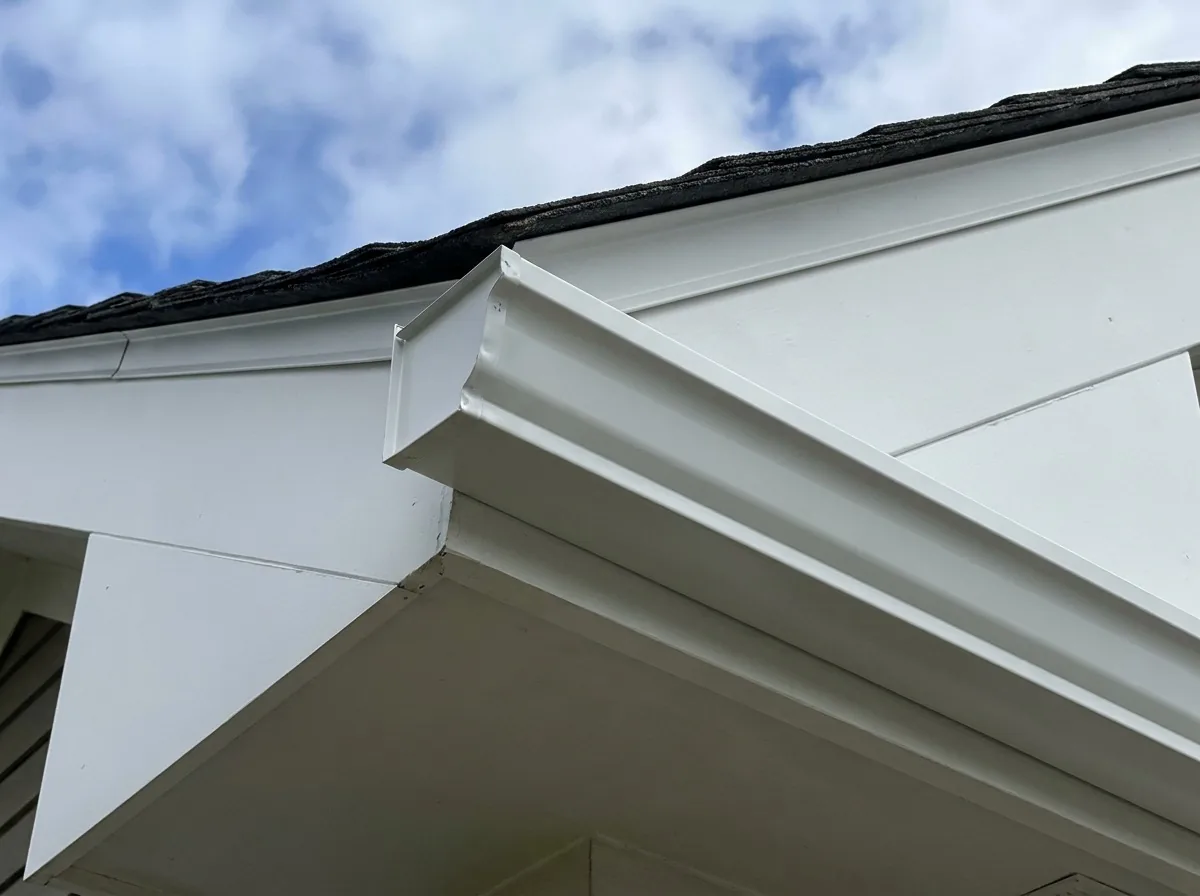
Standard 5-inch K-style gutters handle most single-story Twin Cities homes with moderate roof area, while 6-inch gutters are the right spec when you have a steep pitch, large catchment area, or already see water sheeting over the front edge during heavy summer storms.
A 6-inch K-style run still needs enough outlets so meltwater does not sit in the trough; how many downspouts a Minnesota house needs is the sizing companion to this width call.
Key takeaways
- 5-inch K-style holds roughly 1.2 gallons per foot and handles up to ~5,520 sq ft of roof area at standard pitch — covers most ranches and split-levels built in the 1960s–2000s.
- 6-inch K-style holds about 2.0 gallons per foot — 67% more capacity — and is the right call for two-story homes, steep roofs (8/12+), or long runs between downspouts.
- Upsizing from 5" to 6" adds roughly $2–$4 per linear foot installed (2026 Twin Cities pricing).
- Pair 6-inch troughs with 3×4 downspouts instead of standard 2×3 — the trough is only as fast as the drain it feeds.
- The right answer is not a guess: a tape measure on your roof pitch and catchment area gives the number. Free on-site estimates from EaveX: (763) 313-8516.
How gutter sizing works
Gutter capacity depends on three variables: trough width (the profile), roof pitch, and total catchment area — the square footage of roof that drains into a single gutter run. Industry flow tables published by organizations like the Sheet Metal and Air Conditioning Contractors National Association (SMACNA) match these variables to determine whether 5-inch or 6-inch is adequate for a given design rainfall intensity.
Minnesota's peak rainfall intensity for the Twin Cities metro runs roughly 6–7 inches per hour during a 5-minute design burst (NOAA Atlas 14 data for Hennepin County). If a gutter run collects more water than it can carry at that rate, the overflow misses the downspout and dumps against your foundation wall, into landscaping, and against basement windows.
Undersized gutters cause the same damage as failed gutters — water in the wrong place. Oversized gutters cost more than necessary without delivering additional protection. The goal is matching the system to the actual roof, not defaulting to the cheapest or the biggest option.
Side-by-side comparison
| Feature | 5-Inch K-Style | 6-Inch K-Style |
|---|---|---|
| Capacity per foot | ~1.2 gal | ~2.0 gal |
| Max roof area served (standard pitch) | ~5,520 sq ft | ~7,960 sq ft |
| Standard downspout | 2×3 in | 3×4 in |
| Installed cost (aluminum, 2026) | $8 – $12/ft | $10 – $16/ft |
| Best for | Ranches, split-levels, moderate pitch | Two-story, steep pitch, wide gables |
| Visual profile | Standard residential look | Slightly taller face — blends on larger homes |
All costs are 2026 Twin Cities estimates. Final price depends on total linear feet, number of stories, corner count, and fascia condition.
When 5-inch is enough
Most single-story homes built between the 1960s and early 2000s across Maple Grove, Plymouth, Coon Rapids, and similar northwest-metro suburbs sit on 4/12 to 6/12 pitch with 1,200–1,800 sq ft footprints. A 5-inch seamless aluminum gutter with downspouts spaced every 30–40 feet handles that drainage load comfortably, even during Minnesota's heaviest July cloudbursts.
If your current 5-inch gutters overflow only because they are clogged with leaves, pine needles, or shingle granules — the fix is cleaning and re-pitching, not upsizing. A clogged 6-inch gutter overflows exactly the same way a clogged 5-inch does; the debris does not care about trough width.
Also consider homes with hip roofs. A hip roof splits its catchment area across four sides rather than two, significantly reducing the drainage load on each gutter run. These homes almost always perform well with 5-inch troughs.
When to upgrade to 6-inch
Choose 6-inch when any of these conditions apply:
- Roof pitch is 8/12 or steeper. Water accelerates down a steep slope and hits the trough at higher velocity. The gutter needs more volume to catch the water and slow it before the downspout outlet.
- Catchment area per run exceeds ~5,500 sq ft. This is common on two-story homes with wide gable ends, where the entire front or back face — two full stories of roof — drains into a single gutter run.
- Downspout locations are limited. A porch, covered walkway, driveway, or mature landscaping prevents adding a downspout mid-run. Longer spacing between outlets demands more trough volume to prevent overflow between the drains.
- You already see water sheeting over the front lip. During a hard July storm, if water sheets over the front lip of clean, properly pitched 5-inch gutters, the system is undersized for the roof. The solution is 6-inch, not more frequent cleaning.
The 6-inch upgrade is not just about the trough. Pair 6-inch troughs with 3×4-inch downspouts instead of the standard 2×3. A 6-inch gutter feeding into a 2×3 downspout creates a bottleneck at the outlet — the overflow problem moves from the lip to the connector, but the water still ends up on the ground in the wrong place. Outlets should be spaced every 30–40 feet of gutter run.
What about half-round gutters?
Half-round profiles hold less water per inch of width than K-style because the curved shape wastes cross-sectional area compared to the flat-bottom K-style profile. They also cost roughly 20–40% more installed due to specialized hangers and lower availability.
Half-round gutters work well on historic homes in neighborhoods like Kenwood, Summit Hill, and Crocus Hill where the curved look matches Victorian, Craftsman, or Tudor architecture. For pure drainage capacity per dollar, K-style wins. If aesthetics matter more than marginal cost savings, go half-round in 6-inch — the larger size compensates for the lower flow efficiency.
How does gutter size affect gutter guard compatibility?
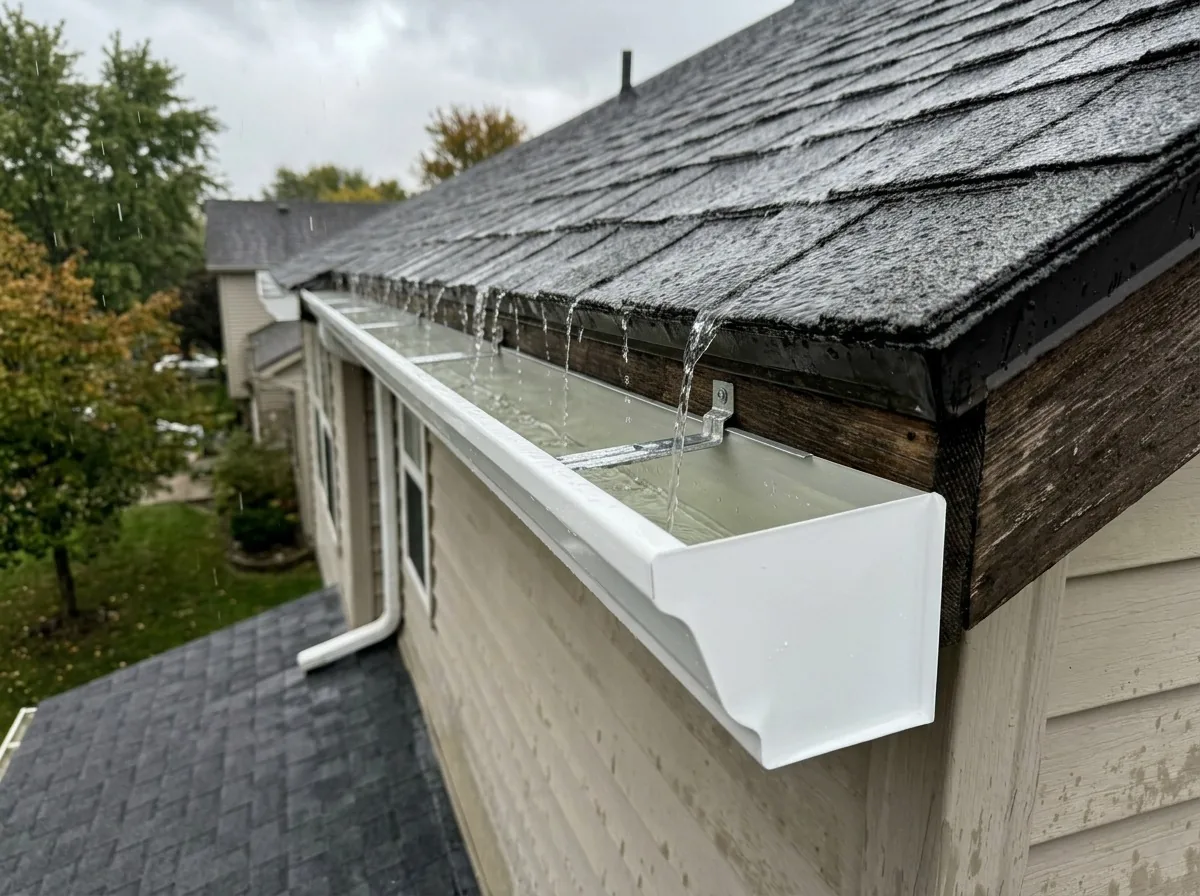
Both 5-inch and 6-inch gutters accept guards, but the guard panel must match the trough width exactly. A 5-inch guard will not seat properly on a 6-inch trough and vice versa. If you plan to add guards later — even a year or two down the road — decide on gutter size first, because switching trough width later means replacing guards too.
Our analysis of gutter guards for Minnesota homes covers which guard styles work best with each gutter size and what to expect in terms of maintenance reduction.
The cost math: is 6-inch worth the upgrade?
For a typical Twin Cities home with 160 linear feet of gutters:
- 5-inch installed: 160 ft × $10/ft (midpoint) = ~$1,600
- 6-inch installed: 160 ft × $13/ft (midpoint) = ~$2,080
- Difference: roughly $480
On a system that lasts 20–30 years (see how long aluminum seamless gutters last in Minnesota), the $480 premium for 6-inch works out to less than $25 per year. If your roof catchment is anywhere near the borderline between the two sizes, upsizing eliminates the risk of overflow damage to your foundation, landscaping, and basement for what amounts to pocket change per season.
On the other hand, if your roof clearly fits within the 5-inch capacity tables — modest pitch, hip roof, plenty of downspout locations — spending extra for 6-inch buys nothing except a slightly larger visual profile on the fascia. It is not wrong, but it is not necessary either.
Common mistakes homeowners make with gutter sizing
Matching the old size without checking the roof. Many homes have undersized gutters installed by a previous owner or builder. If the old 5-inch system overflowed during storms, replacing it with 5-inch again repeats the same problem. Always size to the roof, not to whatever was there before.
Ignoring downspout sizing. A homeowner upgrades from 5-inch to 6-inch gutters but keeps the old 2×3 downspouts. The trough can now hold more water, but the drain has not changed — overflow happens at the outlet instead of the lip. Always match downspout size to trough size.
Oversizing for bragging rights. Some contractors push 6-inch on every job because the material cost is slightly higher and so is the ticket. If your roof does not need 6-inch, you are paying more for no benefit. A professional sizing calculation takes 10 minutes during the inspection.
Get the right spec for your home
Guessing gutter size from the ground wastes money in both directions: undersized gutters overflow, oversized ones cost more than needed. Capacity is separate from system type—seamless vs sectional gutters in Minnesota explains why a taller kit still leaks at every joint. A free on-site inspection measures your roof pitch, catchment area, and downspout placement — then we quote the exact system your roof requires. Check our seamless gutter cost breakdown for 2026 pricing before the visit so you have a frame of reference.
Free inspection / free estimate: call (763) 313-8516 or visit our seamless gutter installation page. EaveX: 1,200+ projects, 5.0 rating, 13+ years in Minnesota, license BC808261. Financing available from 0% APR (0.00–9.99%) with GreenSky — ask during your estimate for the rate you qualify for.